
Evaluating Assessments and Curricula
Last updated on 2025-11-17 | Edit this page
Estimated time: 55 minutes
Overview
Questions
- What did you learn about conducting formative assessments?
- How was the experience of teaching overall?
- What feedback do you have from yourself? From others?
- How will you incorporate this feedback into your teaching in the future?
Objectives
- Refine and improve their process for conducting formative assessments.
- Update course curricula in response to feedback.
Lesson Recap
At the beginning of this course, you got into groups and worked together to design and teach a short lesson. On Thursday and Friday of this week, each group presented their lesson. You had 30 minutes total to introduce your topic, teach it with live coding, and deliver a brief assessment. Afterwards, we had 10 minutes of feedback before moving on to the next group. We gave feedback on both the course itself and the advertisement flyer you wrote last week.
Internal Reflection
You did it! You taught the lesson. The hard part is over. Now, while it’s fresh in your mind, it’s worth taking some time to reflect on how things went, and what you could do differently in the future.
Self Reflection
Take a moment to center yourself. Take a deep breath, maybe close your eyes. Now think about how the lesson went for you. On a red sticky, write down a moment where you felt anxious or uncertain. On a green sticky, write down a moment where you felt really good about how things were going.
Evaluating the Assessment Phase
We’ll go over the lesson as a whole in a moment, but let’s start by spending some time on the assessment portion specifically:
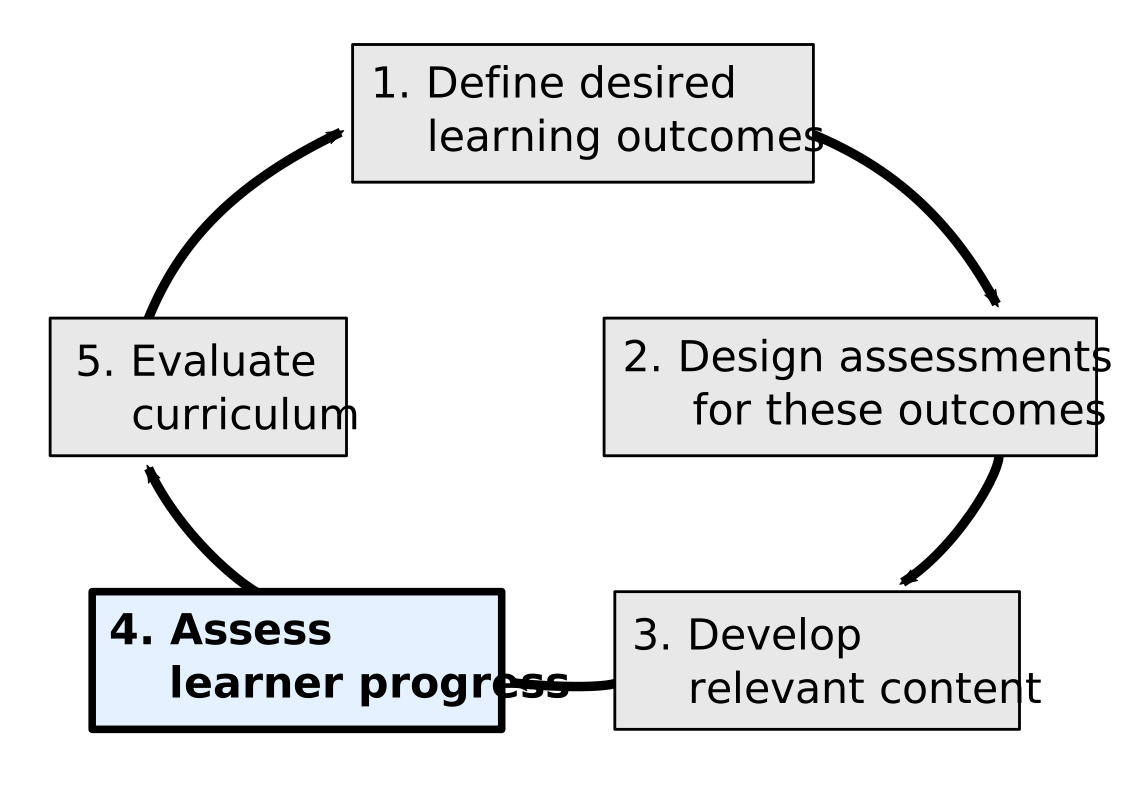
Even if you have taught before, you might be new to the practice of regular formative assessments during class. What went well about the assessment? What challenges did you experience? Did you feel that you were able to adapt your material in response to the assessment? Did you have fun?
Assessing the Assessment
On a sticky note, write down one thing you will do differently next time you run a formative assessment.
You can refer back to the Designing Assessments section at any time to get more inspiration about how to run formative assessments in the future.
Evaluating the Curriculum
Ok, now we can zoom out from the assessment to think about the curriculum overall. Let’s talk through the internal-reflection notes you wrote earlier, and discuss some common themes.
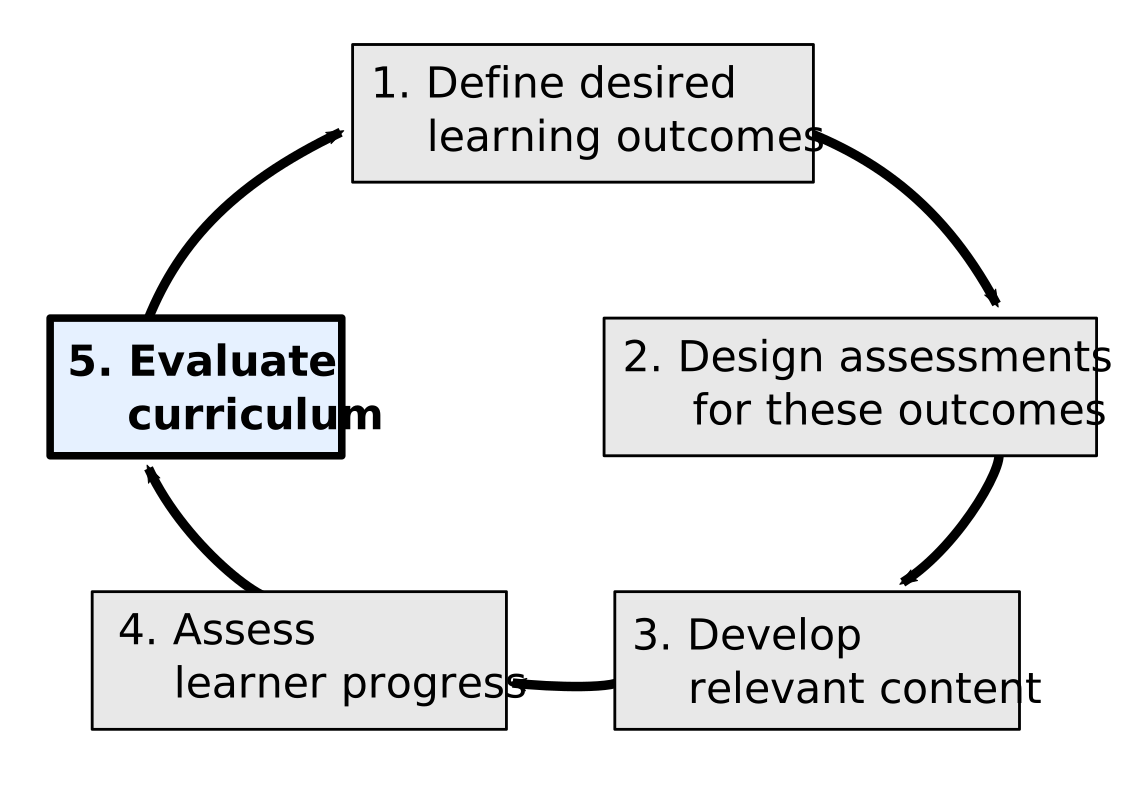
You also got some feedback from your peers right after the lesson. We’re going to collect all those notes and distribute them to you in the coming days.
What feedback did you find most helpful about your content? What feedback did you find most helpful about your delivery?
What are you most proud of? What’s the first thing you want to change next time?
It’s a good idea to sit with all the feedback you’ve received and categorize it:
- What are things you want to modify with high priority?
- What are things you want to modify with low priority?
- What feedback will you respectfully leave behind?
Surveys
Even if you never ask your course participants for feedback, you can still evaluate your curriculum based on your own experience of the lesson using some of the questions we listed above. We strongly recommend asking your participants for feedback, but you can do so a few different ways.
For the purpose of these short lessons, we asked participants to give live feedback. They were probably pretty forthright about it because these people are your peers. But in a real classroom setting, people might feel uncomfortable giving constructive feedback straight to your face. This is where anonymized surveys come in handy.
The Pre-Survey
Pre-surveys are less common than post-surveys, but we find them to be very useful for assessing the impact of the course.
For this training, all of you began by taking a pre-course survey that helped me understand what interest and experience level you were starting from. This allowed me to design content at a pace and level that I thought might be most appropriate. I also asked you to self-evaluate your own skills at different teaching tasks. In the post-survey, I will ask you to self-evaluate those same questions to see if your perception of your skill has changed.
The Post-Survey
Post-course surveys allows participants a safe and anonymous space to provide feedback. If you conducted a pre-survey that included self-evaluations of skills, include those same questions again to assess how those self-evaluations have changed. Post-surveys will additionally include questions about the course content itself, what went well or poorly, and how we could improve in the future.
Creating an anonymous post-survey is a great way of showing your course participants that you’re committed to improving. Filling out the post-survey is a wonderful way of respecting your instructor, and helping them on their growth journey. The less you enjoyed the course, the more helpful your feedback might be.
If you are looking for inspiration on how to design surveys, the Carpentries makes their survey questions publicly available. We modified the Instructor Training surveys for this course, but the standard pre-and post-workshop surveys are more appropriate if you’re teaching a technical topic.
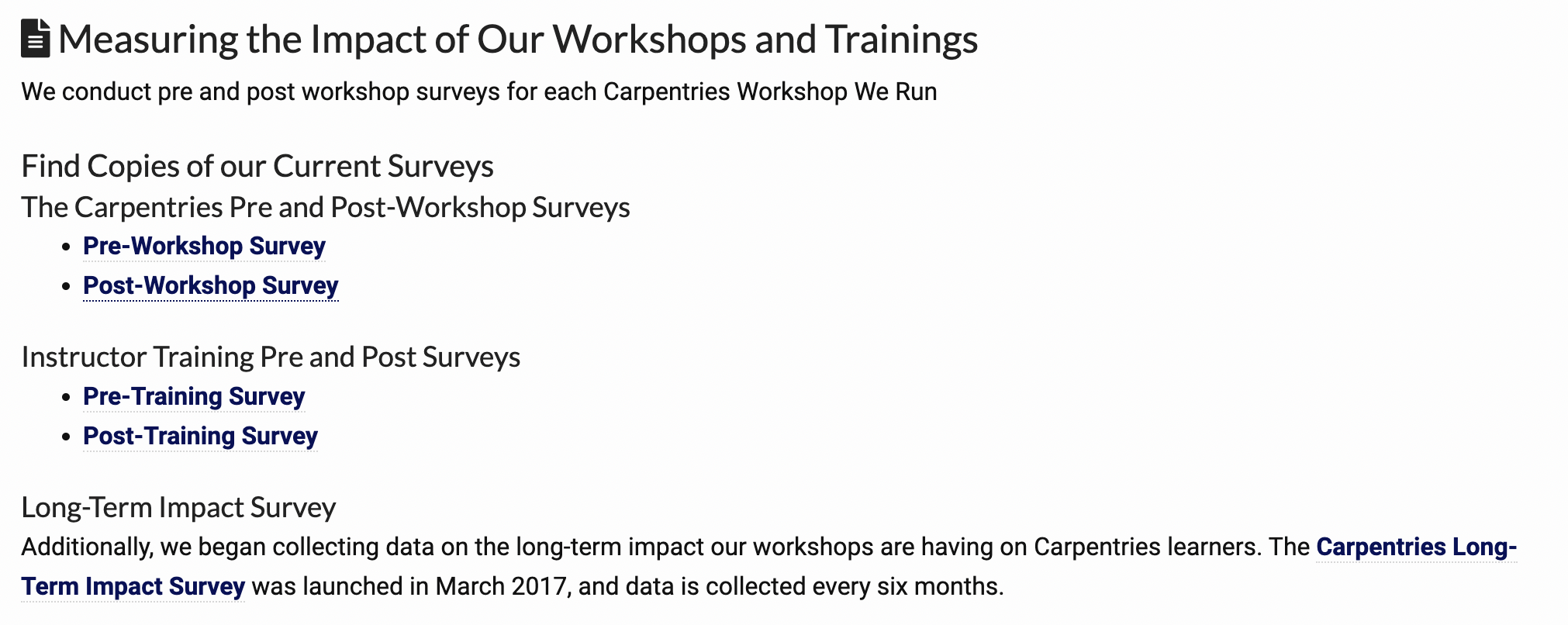
- Your skill and comfort with running formative assessments will grow over time.
- It is always beneficial to reflect on your own perception of your performance after teaching.
- Asking course participants for feedback can help you improve your teaching process.
- In the future, you should consider a formal pre-post survey framework to help you evaluate your curriculum.