
Designing Assessments
Last updated on 2025-11-17 | Edit this page
Estimated time: 95 minutes
Overview
Questions
- Why are exercises so important in a lesson?
- What are some different types of exercises, and when should they be used?
- Why should we create assessments before we have written the explanatory content of our lesson?
Objectives
After completing this episode, participants should be able to…
- Describe the importance of regular assessment while a lesson is being taught.
- Choose the format for an exercise based on the outcome it is intended to measure.
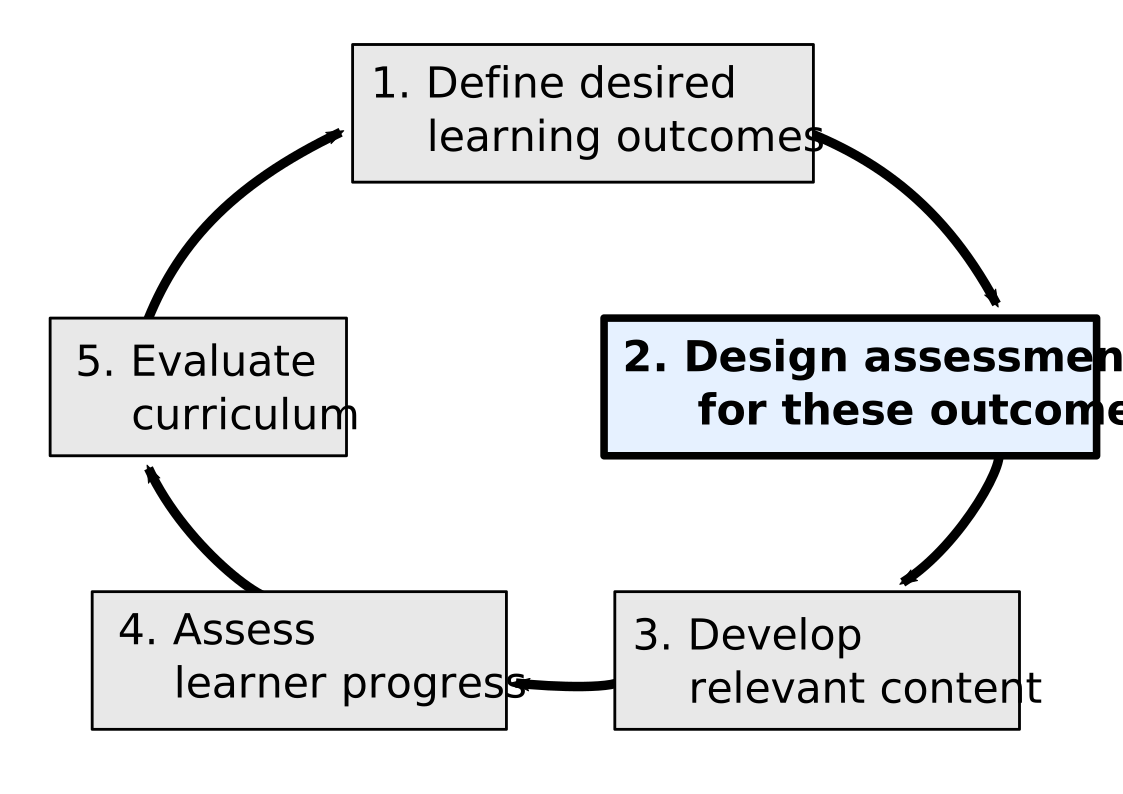
As we have seen previously, defining objectives for a lesson (or a teaching episode) can help to focus your content on the most important learning outcomes and outline the scope of your lesson project. The goal of the remaining steps of lesson development is to ensure that what learners learn from following your lesson matches its defined objectives as closely as possible. To do so, you need to develop assessments to monitor progression towards your learning outcomes.
Useful reading
Useful further reading: Course design: Considerations for Trainers – a Professional Guide.
Exercise Your Memory
In a simplified model of memory individuals are equipped with two types of memory: working (also called short-term) and long-term. Long-term memory essentially has unlimited storage but is slow to access, whereas working memory is quicker to access but can only hold a limited number of items at a time. For teaching, the goal is to help learners move the new things they’ve learned from working memory into long-term memory. One of the ways lesson developers can aid in this process is through exercises.
In addition to checking for misconceptions and broken mental models, exercises help move new skills and concepts into long-term memory by providing learners an opportunity to practice what was recently learned. These exercises should occur frequently throughout the lesson because they move items to long-term memory and free up learners’ working memory for new items.
Creating exercises builds upon the learning objectives you created earlier in the lesson design process. You can design exercises based on the actions/skills you described in your learning objectives (the learning outcomes you intend for the lesson). This will be easier if your wrote learning objectives with specific action verbs. Specific verbs can help you decide what action you want the learners to perform in the exercise. E.g. actions such as “explain” and “describe” may be better assessed by discussions and multiple choice questions, while “solve,” “construct,” “test” and other higher-level cognitive skills may be better assessed by debugging tasks, code-and-run, or use-in-a-different-context exercises.
Resources to Explore for More Example Assessment Types
Exercise: Exercise Types and When to Use Them (15 minutes)
The Trainers will assign you to pairs or small groups, and give each group an exercise type to focus on. Each group should assign a notetaker, to summarise your discussion at the end of the exercise.
Read about your given exercise type in the Exercise Types chapter of Teaching Tech Together by following the relevant link below.
Then, discuss the following questions together:
- What kind of skills would an exercise of this type assess? Try to identify some action verbs like those we used to write lesson objectives earlier in the workshop.
- Would this type of exercise be suited to a novice audience? Or is it a better fit for intermediate or advanced learners?
- Would this kind of exercise work well in an in-person workshop setting? Would it be better suited to self-directed learning and/or a virtual workshop?
Share the major points of your discussion in the collaborative notes document.
As you discussed with your group in the last exercise, different types of learning objectives work better for novices, while others are a better fit for competent practitioners or experts.
This can be understood in terms of the types of exercises that suit the objective: exercise types that help manage cognitive load for the learner, such as fill-in-the-blanks, faded examples or Parsons problems (which all provide a lot of the guiding process/scaffolding code and allow the learner to focus on a specific concept or skill) are a good fit for a novice, to whom all elements of the topic are new. However, these kinds of exercise do not provide an opportunity for learners to develop higher-level skills, such as the ability to create whole new functions or scripts, or to extrapolate from the examples they have seen to solve a different kind of problem. Indeed, example and exercise types that are helpful to novices may even be counter-productive for learners with a greater level of expertise1.
Thus you want to choose your objectives to fit your intended audience and your exercise formats to fit your objectives.
“Different types of lesson objectives (LOs) are better fit for novices, while others are better fit for competent practitioners, etc. and if exercises (formative assessments) are well aligned to LOs, [they] will automatically serve the corresponding audience. Thinking in terms of LOs (What should a learner do in order to achieve this specific LO? Is this LO exactly what learners are expected to achieve by the end of this piece of instruction? etc.) is easier than thinking in terms of LOs + audience + content. LOs should be tailored to the audience, and, if this is well done, you may stop worrying about the audience. Create LOs for the specific audience and create assessments for specific LOs.”
- Dr. Allegra Via, Carpentries Instructor Trainer
Exercise: Assessing Progress Towards an Objective (30 minutes)
Using one of the exercise formats you have learned about so far, design an exercise that will require learners to perform one of the actions described in the objectives you wrote earlier, and that assesses their ability to do so.
These should be assessments of the lower-level objectives defined for individual episodes in the lesson, as opposed to the lesson-level objectives you wrote first.
Trainees working as a team can choose whether to work together on discussing and designing a single exercise to assess a single objective, or to divide their efforts and each focus on an exercise for their own episode. If you choose to take the latter approach and finish with time to spare, spend the remainder reviewing and providing feedback on one another’s assessments.
Assessing Knowledge Before a Workshop
The same approach to designing exercises within a lesson can also be used to create a short “re-assessment” questionnaire for potential learners to complete when they register for a workshop teaching the lesson (or for self-evaluation before following the lesson on their own). You can use the list of prerequisite knowledge that you defined earlier to help with this.
If you collect the results of this questionnaire, use it to follow up with people who have registered for the workshop but do not fit the intended target audience, to manage their expectations about how useful the workshop will be for them.
- Assessments are a way to determine whether the objectives you defined for the lesson have been reached.
- Exercises are important for learners to move what they’ve learned to long-term memory.
- Some types of exercises are better for particular audiences and to address certain objectives.